
1. Introduction: What Is the Internet Archive?
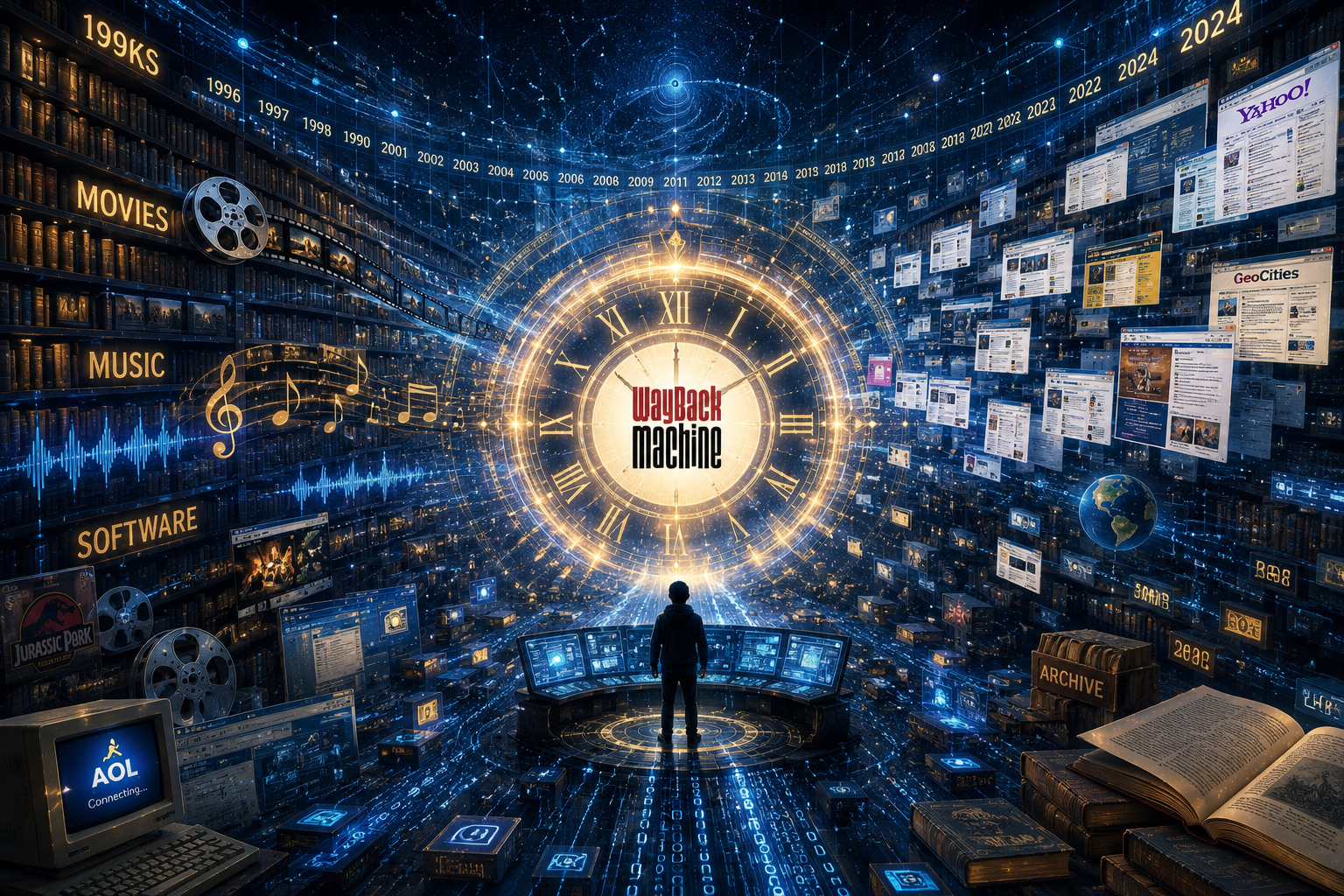
Imagine walking into a library that holds not just millions of books, but every version of every website that has ever existed, decades worth of music, classic films, vintage software, and academic research — all completely free. That is exactly what the Internet Archive offers. Founded in 1996 by Brewster Kahle, the Internet Archive was built on one powerful idea: that knowledge should be universally accessible to everyone, regardless of where they live or how much money they have.
Headquartered in San Francisco, California, it operates as a non-profit organization running archive.org — open to anyone with an internet connection. Over nearly three decades, it has become one of the most important institutions on the internet, housing over 35 million books, 14 million audio recordings, 8 million videos, and more than one trillion archived web pages. Its mission remains as bold as ever: “Universal access to all knowledge.”
2. The Wayback Machine: Travel Back in Time Online
The Wayback Machine is the Internet Archive’s most famous feature. Launched publicly in 2001, it works like a time machine for the internet — type any URL and it shows you exactly what that page looked like at different points in history, even if the site no longer exists today. As of October 2025, it crossed the milestone of one trillion archived web pages, representing over 100,000 terabytes of data.
For everyday users, it is endlessly practical. Want to see what Google looked like in 1998? Need to check how a news article read before it was quietly edited? Trying to recover a deleted webpage? The Wayback Machine makes all of this possible. For journalists, lawyers, and researchers, it has become an indispensable tool for verifying facts, tracking changes in public information, and holding institutions accountable in the digital age.
3. What Can You Find in the Internet Archive?
Most people discover the Internet Archive through the Wayback Machine, but the full collection goes far beyond web pages. It is a genuinely vast digital library spanning an extraordinary range of media and historical periods.
| Collection | What It Includes |
| Texts & Books | 35 million+ books, papers, magazines, and documents |
| Audio | 14 million recordings, concerts, radio, and the Great 78 Project |
| Video | 8 million films, documentaries, and classic TV episodes |
| Software | 800,000+ programs and vintage video games |
| Web Pages | 1 trillion+ captures via the Wayback Machine |
| Images | Millions of photographs and historical illustrations |
The Open Library lets users borrow digital books like a traditional public library, but online and worldwide. The Great 78 Project works to digitize hundreds of thousands of fragile gramophone records before they deteriorate. Thousands of public domain films can be streamed or downloaded instantly, no account required. For retro gaming fans, classic software can even be run directly in the browser through built-in emulation — a genuinely magical experience.
4. How the Internet Archive Supports Researchers, Journalists & Educators
The Internet Archive is a serious, heavily relied-upon resource for professionals across many fields. Journalists depend on it when governments remove policy documents, companies delete press releases, or news articles are edited without public notice. In those moments, the Archive often holds the only surviving original copy — making it an essential tool for accountability journalism and fact-checking.
Researchers and academics benefit from access to 35 million scholarly documents through Internet Archive Scholar, covering everything from digitized eighteenth-century journals to modern open-access preprints. Educators also find immense value here — history teachers can show students a newspaper’s actual front page on the morning of a major world event, while students can access primary sources that would otherwise sit behind expensive paywalls. As one digital preservation expert put it:
“The Internet Archive preserves not just websites, but the record of how we communicated, what we believed, and how we changed.”
5. The Challenges Facing the Internet Archive Today
Despite its value, the Internet Archive has faced serious challenges in recent years spanning legal battles, cyberattacks, and growing tensions with publishers.
On the legal front, four major publishers — Hachette, HarperCollins, Penguin Random House, and Wiley — sued the Archive over its Open Library lending program. Courts ruled against the Archive in 2023, upheld on appeal in 2024, resulting in over 500,000 books being removed. Music giants Universal Music Group, Sony Music, and Concord separately filed a $621 million lawsuit over the Great 78 Project, settled confidentially in September 2025.
On the cybersecurity front, October 2024 brought the worst crisis in the Archive’s history. Hackers stole a user database containing 31 million records — including email addresses, usernames, and hashed passwords — accompanied by damaging DDoS attacks that knocked services offline. Meanwhile, major publishers including The New York Times have begun blocking the Archive’s web crawlers, citing AI scraping concerns. The Electronic Frontier Foundation has warned this risks erasing large portions of the public historical record permanently.
6. How to Use the Internet Archive: A Beginner’s Guide
Getting started with the Internet Archive is simple and free. Here is how to make the most of it:
Using the Wayback Machine:
- Visit web.archive.org
- Enter any URL and select a year from the timeline
- Click a highlighted date to view the archived snapshot
Borrowing a Book:
- Go to openlibrary.org
- Search for a title, click “Borrow,” and create a free account if prompted
- Read directly in your browser or the free app
Watching Free Films:
- Visit archive.org/details/movies
- Browse and stream instantly — no account needed
Playing Vintage Software & Games:
- Go to archive.org/details/software
- Click “Run in Browser” to launch directly via emulator
A free account also unlocks full-text search inside digitized books and documents, the ability to upload your own content, and access to a broader selection of borrowable titles.
Conclusion
The Internet Archive is one of the most extraordinary and quietly vital institutions of the digital age. In a world where websites vanish overnight and articles are edited without notice, it stands as a determined guardian of our collective digital memory. From the trillion-page Wayback Machine to its vast libraries of books, music, and films, it offers something no commercial platform does — truly free, open, and permanent access to human knowledge.
It faces real challenges from publishers, hackers, and the pressures of an AI-driven internet. But after nearly three decades of growth fueled by donations and dedication, the Internet Archive remains your best free gateway to the entire history of the web.
FAQs
Q1. Is the Internet Archive completely free?
Most content is accessible without an account. A free account unlocks borrowing and uploading features.
Q2. Is it legal to use?
Content is either public domain or openly licensed. The Archive operates legally as a non-profit library under U.S. law.
Q3. How far back does the Wayback Machine go?
The earliest saved page dates to May 10, 1996, though coverage varies by website popularity.
Q4. Was the Internet Archive hacked?
In October 2024, a breach exposed 31 million user accounts. Affected users were advised to change their passwords immediately.
